

Transition Lab
An inter-school laboratory for experimenting with the ecological transition
The Transition Lab is an inter-school laboratory run by Äerdschëff asbl, dedicated to citizen-led research, active learning and ecological experimentation.
It supports secondary school pupils, particularly eco-ambassadors, as well as teachers and partners in the field, in a practical approach: observing reality, formulating questions, testing ideas, debating results and producing resources useful to other schools.
The aim is to enable young people to better understand the major challenges of the ecological transition, not in an abstract way, but through lived, observed and documented experiences. The Transition Lab thus becomes a space where one learns to connect technical choices, everyday practices and ecological impacts.

Sustainable mobility: learning through exploration
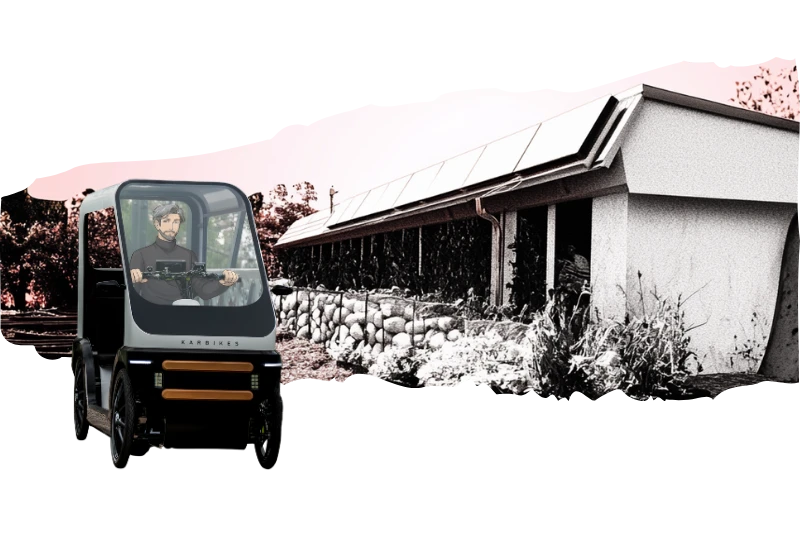
Sustainable mobility is one of the Transition Lab’s primary areas of experimentation. Building on the ‘Imagination powered transition’ project, light intermediate vehicles (LIVs), such as Karbikes, are being used as tools for learning.
These vehicles raise very practical questions: how can we travel differently in Luxembourg? Which short journeys could be made without a private car? What obstacles do residents, pupils or local authorities face? What infrastructure, skills and habits would need to change?
ILVs thus become subjects for investigation, testing and debate. They enable us to explore the links between mobility, energy, materials, repairs, safety, accessibility and spatial planning. By observing them, testing them and discussing their uses, young people learn to question a technical solution in all its complexity.
Experiment, discuss, share
Each project follows a simple process: understanding a problem, gathering observations, testing a hypothesis, discussing the results, and then documenting what has been learnt.
This method connects the school to the local area, knowledge to action, and ideas to the realities on the ground. Young people can conduct interviews, observe practices, compare scenarios, test a prototype or organise a group presentation.
The results then take the form of fact sheets, experiment reports, teaching materials or recommendations. The aim is to produce clear, reusable resources capable of inspiring other classes, other schools or other partners. Each experiment thus becomes a small part of a broader collective learning process.

A project anchored to the Earthship
The Äerdschëff building serves as a hub for meetings, expert-citizen forums, presentations and discussions. It provides a practical setting for bringing together issues relating to low-tech solutions, mobility, circular manufacturing, energy, resources and citizen participation.
This space makes it easy to move from reflection to experimentation: discussing an idea, observing a system, testing a solution, then collectively reviewing what works and what doesn’t. Äerdschëff thus becomes a living learning environment, where young people can understand the ecological transition through objects, practices and concrete choices.
With the Transition Lab, Äerdschëff asbl offers a framework for learning to pivot collectively: less abstract talk, more research, prototypes, debates and replicable actions.
